This is a viewer only at the moment see the article on how this works.
To update the preview hit Ctrl-Alt-R (or ⌘-Alt-R on Mac) or Enter to refresh. The Save icon lets you save the markdown file to disk
This is a preview from the server running through my markdig pipeline
Saturday, 26 September 2026
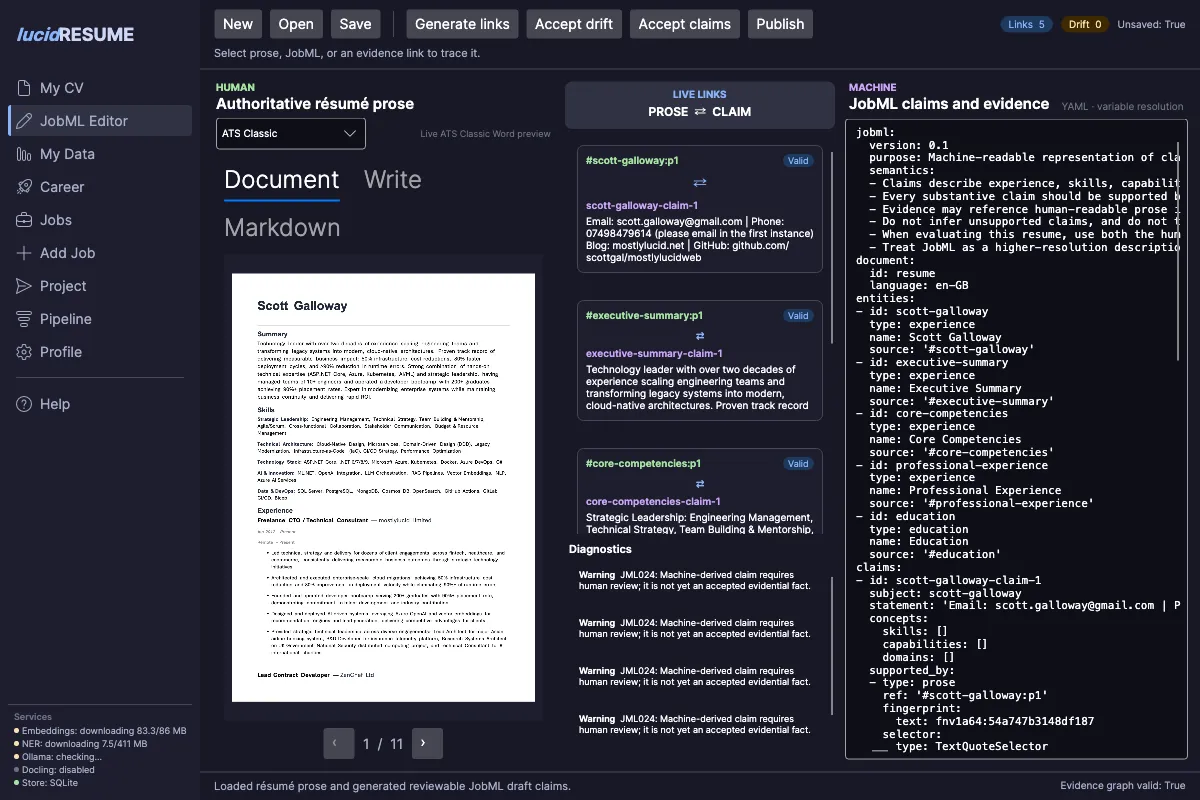
I asked lucidRESUME for an Engineering Lead résumé.
It produced two pages covering six relevant roles, two recent projects and the skills which mattered to the target. The prose was the prose I had already reviewed. Twenty-eight inline links connected the statements to eleven compact references. The public projects retained their repository or product links. The other references named the exact role in my fuller career transcript.
That sounds rather like an AI résumé generator. It is almost the opposite.
An AI résumé generator starts with a prompt and tries to write a plausible candidate. This starts with a reviewed career record and removes everything which does not answer the job description. An optional model can tighten the selected prose, but it cannot add a role, number, technology or claim which the selection did not already contain.
The distinction is simple:
The job description chooses a view of the evidence. It does not get to choose a more convenient person.
This is part three of my lucidRESUME experiment. Part one introduces the evidence ledger, JobML and the scientific-paper model for professional claims. Part two uses Chrome's local model to map unfamiliar job-form questions to a published JobML career record. This part joins the two together with the practical bit: paste a job description into a small web control and compile a conventional Word or PDF résumé from the complete record.
NOTE: lucidRESUME remains a research project. This article describes the current implementation, not a finished recruitment product.


My normal résumé is a dreadful source document because it has been compressed and rewritten for years. Every edit answers one vacancy while quietly removing something which may matter to the next one.
The source for this experiment is intentionally excessive. It combines old résumés, LinkedIn, reviewed role descriptions and a selected set of repositories, public products and articles from this site. The human transcript is more than ten pages because it is not intended to be sent to a recruiter. It is the fuller account from which smaller documents are compiled.
The public-work audit makes the reason obvious. At the time of writing my GitHub account has 47 public, non-fork repositories. Thirty-one have activity since the start of 2025. A NuGet search for Mostlylucid returns 175 package IDs owned by that account. The local article collection contains 113 posts which directly link to one of my GitHub repositories or Mostlylucid packages.
The audit also caught an important limitation in my supposedly complete source. Its prose names six GitHub repositories and no individual NuGet package URLs. It contains the projects I happened to consider important while writing it, not the full breadth needed for arbitrary future job matching.
Putting all 175 packages in a two-page résumé would be deranged. Leaving their useful evidence out of the career record would also be wrong.
The ledger therefore needs to store breadth at artefact resolution while the résumé shows only the small number of artefacts which help answer this job. Package modules can be grouped under product families such as StyloBot, LucidRAG, StyloFlow and Ephemeral. The individual package identities remain searchable without pretending that each is a separate grand project.
flowchart LR
    A[Old résumés and LinkedIn] --> L[Private reviewed ledger]
    B[GitHub repositories] --> L
    C[NuGet packages] --> L
    D[Articles and products] --> L
    L --> J[Full JobML career record]
    J --> R[Role-specific résumé]
    R --> W[Word and PDF]
    R --> K[Compact cJobML references]

    classDef human fill:none,stroke:#4f8cc9,stroke-width:2px;
    classDef evidence fill:none,stroke:#4fa66d,stroke-width:2px;
    classDef output fill:none,stroke:#b07ac4,stroke-width:2px;
    class A,L,J,R human;
    class B,C,D evidence;
    class W,K output;
There are three different things in that diagram which are easy to conflate:
career_record is the complete portable projection of that ledger. It
contains the full human transcript, claims, evidence, concepts and optional
semantic data.JobML is not synonymous with the ledger, and cJobML is not another authoring format. Each is a view with a different resolution.
The public projects are useful precisely because they cover more ground than I would claim as my day job.
For example, Directed Synthetic Evolution and mostlyucid-nmt contain substantial Python implementations. The latter packages EasyNMT behind production-ready GPU and CPU Docker variants. DSE explores multi-model program synthesis, evaluation and RAG-backed reuse.
I would not describe myself as a commercial Python developer on that evidence. I would say that I conceived and built working Python-heavy research systems, largely through LLM-assisted development, and can discuss their architecture, evaluation and product decisions. That is both useful and honest.
The same distinction applies to TypeScript and JavaScript. The Mostlylucid site, StyloBot, lucidRESUME and the Smart Copy Alt browser extension contain working front-end or extension code. Those repositories demonstrate cross-stack product delivery and the ability to use coding models effectively outside my principal C# stack. They do not magically turn twenty years of .NET experience into twenty years of TypeScript experience.
The ledger needs enough vocabulary to preserve that difference:
observations:
  - repository: mostlylucid.dse
    language: Python
    basis: github-linguist

claims:
  - statement: >
      Conceived and built a Python-heavy experimental system for
      LLM-orchestrated program synthesis and automated evaluation.
    review: accepted
    supported_by:
      - type: repository
        uri: https://github.com/scottgal/mostlylucid.dse
      - type: article
        uri: https://mostlylucid.net/blog/dise-architecture-overview
The language is an observation. The project statement is a reviewed claim. The repository exposes the artefact. The article exposes the reasoning. A separate claim such as “commercial Python specialist” would require separate evidence.
That is far more useful for matching than a binary skills: [Python] entry. A
job compiler can treat it as relevant adjacent evidence, show it to the person,
and avoid pretending it establishes something stronger.
The weblog matters here. It is an old-fashioned public engineering notebook, not a corporate content funnel. Posts such as the DSE architecture overview, the StyloFlow workflow design, the ephemeral execution library, the ConsoleImage time-boxed tool, and DoomSummarizer's evidence-grounded research flow provide much higher-resolution context than a bullet point can carry.
This does not make every article proof that a production deployment succeeded. It does make the claim inspectable. A reader can see the code, then follow the design argument rather than taking a compressed sentence on trust.
For the worked example I used a general Engineering Lead target. It asked for a hands-on .NET lead who still writes production code, owns delivery, makes architectural decisions, improves CI/CD and observability, mentors engineers and uses AI-assisted development practically.
That is a query over the record, not a writing prompt.
The compiler detected the requirements, matched them against reviewed concepts and claims, and selected six of the fourteen parsed roles. It chose recent Mostlylucid, Mortgage Automator and Zenchef work, then retained earlier Seamcor, WCOM and H3Space examples where they supplied delivery, platform and leadership evidence. It selected Stylo.Bot productisation and DSE as the two public projects which best explained the recent AI work.
The result did not include every interesting thing I have done. Microsoft, the ASP.NET MVC first release and older performance work remain visible in the complete transcript. The repository and package audit is the next increase in resolution: the browser extension and package families should become searchable evidence without being forced into this projection.
That is the important reversal. Nothing is deleted from the professional history to make a résumé. A résumé is an ephemeral view which can be rebuilt when the question changes.
flowchart LR
    JD[Job description] --> Q[Requirements]
    Q --> M[Match reviewed claims]
    CR[Complete career record] --> M
    M --> P[Plan sections and ordering]
    P --> T[Optional bounded tightening]
    T --> V[Validate against selected evidence]
    V --> O[Résumé plus cJobML]

    classDef query fill:none,stroke:#d08a37,stroke-width:2px;
    classDef record fill:none,stroke:#4f8cc9,stroke-width:2px;
    classDef process fill:none,stroke:#4fa66d,stroke-width:2px;
    classDef output fill:none,stroke:#b07ac4,stroke-width:2px;
    class JD,Q query;
    class CR record;
    class M,P,T,V process;
    class O output;
The deterministic path can stop before T. In that mode the selected text is
exactly the reviewed source prose. If local LLamaSharp or OpenAI is enabled, the
model receives only the selected passages and performs bounded editing passes.
The validator rejects a pass which introduces an unsupported number, target-job
technology, evidence identity or section.
This is not a claim that a validator can prove arbitrary prose true. It is a much narrower and more useful guarantee: the editing stage cannot quietly escape the facts selected by the deterministic stage.
The generated document still looks like a résumé. A person sees a short summary, recent roles, selected projects, skills and education. They do not need to read YAML or understand JobML.
The difference is the small linked number after a statement:
Took technical ownership of Formitable after its acquisition by Zenchef,
inheriting a distributed .NET and Azure platform serving more than 5,000
restaurants across Europe. [[4]](#ref-4)
At the end of the document, cJobML renders a familiar reference list:
## References

cJobML 0.1: xref [n] in prose resolves to ref [n].
Full JobML: <https://resume.example/jobml/4f8c...>.

<a id="ref-4"></a>[4] “Complete transcript: Lead Contract Developer,
Zenchef / Formitable.” [Career Transcript]
<https://resume.example/jobml/4f8c...#formitable-role>.

<a id="ref-8"></a>[8] “Stylo.Bot Productisation.” [Project]
<https://stylo.bot/>.
Word and PDF display the same [4] and [8] markers as internal links. The first
click reaches the compact reference. Where a full endpoint is published, the
reference links to the exact role or project in the complete transcript, not
merely the top of a large file.
The distinction between those two examples is intentional. The Formitable link shows the fuller candidate-maintained account. It is provenance, not an employer attestation. The Stylo.Bot link reaches a public product. A repository, article, release or qualification may provide stronger and more independent support. The format names the evidence class instead of pretending all links prove the same thing.
cJobML leaves out selectors, quoted passages, fingerprints, review state, embeddings and concept graphs. Those belong in full JobML. Its job is to remain small enough to append to an ordinary résumé while retaining one-shot machine parsing and human navigation.
The web compiler is the deliberately boring product surface for all of this.
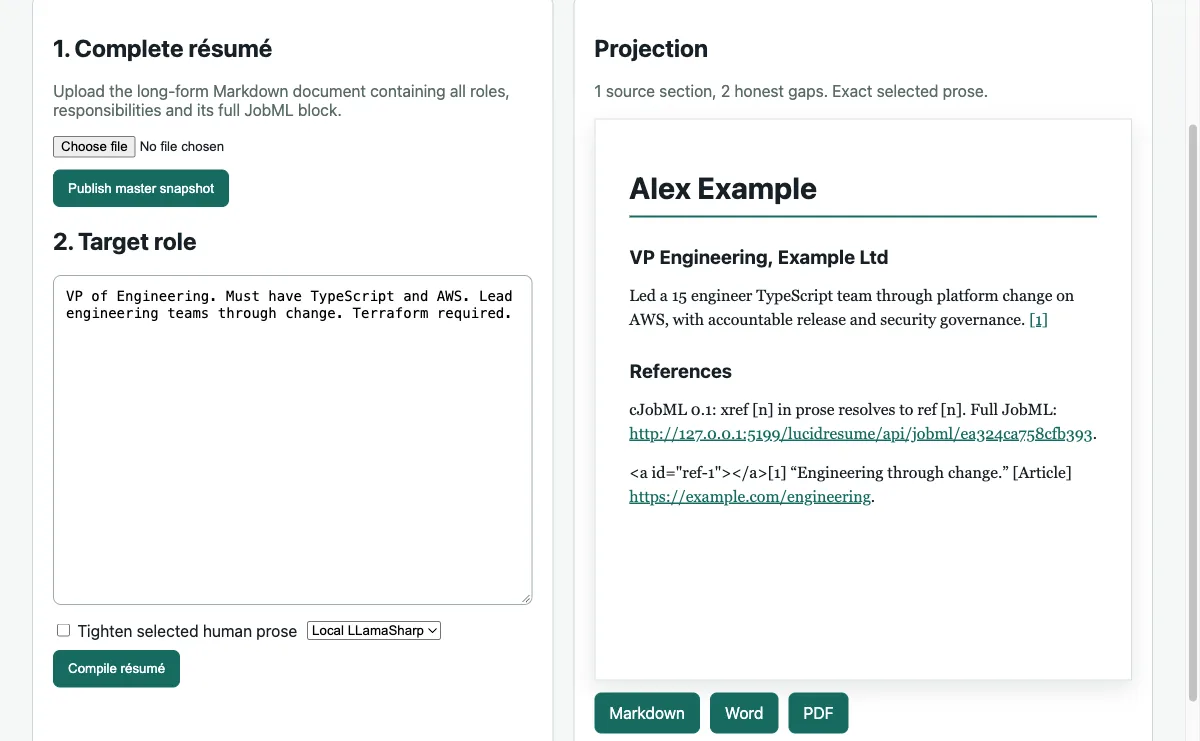
It does not ingest LinkedIn, crawl GitHub or reconcile old résumés. The desktop
application performs that slow, private and review-heavy work. The web control
accepts the already-built JobML career_record, publishes an immutable revision,
accepts a job description and returns Markdown, Word and PDF projections.
Embedding it in an ASP.NET Core application takes the rather pleasing amount of code below:
builder.Services.AddLucidResumeCompiler(builder.Configuration);

var app = builder.Build();
app.UseAntiforgery();
app.MapLucidResumeCompiler();
app.Run();
The important endpoints are equally small:
POST /lucidresume/api/career-record
POST /lucidresume/api/compile
GET  /lucidresume/api/jobml
GET  /lucidresume/api/jobml/{revision}
GET  /lucidresume/api/export/{id}/docx
GET  /lucidresume/api/export/{id}/pdf
The current record has a convenient stable URL. Each published revision also has an immutable URL with an ETag and long-lived cache headers. The compiler places that revision URL in the generated cJobML, then adds entity fragments to the individual transcript references.
That makes a generated document reproducible. Its references do not silently start pointing at next week's edited career record.
The control can run its deterministic selection without a generative model. A small local model through LLamaSharp can parse or tighten text. OpenAI can provide a stronger optional editing pass. Provider keys remain server-side. In either case the evidence selection exists before prose composition and is validated after it.
The products look similar if reduced to “paste job, receive résumé.” Their failure modes are not similar.
| Generic AI résumé generator | Career-record compiler |
|---|---|
| Treats the old résumé and advert as prompt material | Treats the advert as a query over reviewed claims |
| Model decides what facts and wording would fit | Deterministic selection decides which evidence is available |
| Missing coverage invites plausible completion | Missing coverage remains a gap |
| Rewrites the candidate on every run | Reuses stable claim and evidence identities |
| Output is difficult to trace back | Inline citations reach compact and full-resolution evidence |
| Often optimises for “human-looking” model prose | Starts with human prose and makes model editing optional |
| Keyword density can dominate | Human prose and machine representation have separate jobs |
I am not opposed to model-generated text. lucidRESUME can produce a draft or sample during an explicit authoring workflow. I can edit it, reject it or accept it into the human transcript. That is different from allowing generation during rendering to become new evidence.
The complete transcript can also be summarised. A ten-page role description may be tightened to three bullets for a particular vacancy. JobML can remain at high resolution, retain the original evidence and expose a path back to it. The short prose and detailed machine account do not need to have the same loss function.
The human résumé optimises for comprehension, credibility and narrative. JobML optimises for explicit structure, retrieval and verification. cJobML optimises for a compact published bridge between the two.
Part one built the record. This compiler turns it into a role-specific document. Part two's browser extension consumes the same published record when a recruitment site asks for the information again.
private evidence ledger
    -> published JobML career record
    -> job-specific résumé plus cJobML
    -> reviewed form answers
No stage needs permission to invent a new Scott Galloway.
The immediate work is less glamorous than asking a larger model to write more confident prose. The full record needs a proper inventory of repositories, NuGet package families and linked articles. Repository language must remain an observation rather than a proficiency claim. Package modules need grouping under their parent products so 175 package IDs do not become 175 fake “projects.” Article links need to attach to the claims they actually explain.
That detail is the point. If a vacancy asks about Python, TypeScript, browser extensions, local models, workflow orchestration, document extraction or release engineering, the compiler should be able to find a real artefact and show exactly what it establishes. It should also be able to say when that evidence is adjacent, self-published or insufficient.
The interface remains wonderfully small:
Paste the job. Get the right version of you.
Underneath, it is a career evidence compiler. The résumé is simply its first useful output.

© 2026 Scott Galloway — Unlicense — All content and source code on this site is free to use, copy, modify, and sell.
